Update Tagline
 Update About
 Update City Info
 Update Display
 Explore Rooms & Locations
 Subscribe & Follow to Earn Points
 Check Out Leaderboards
 Choose Your Persona



Check out our latest post on EscaperX: How Long Do Escape Rooms Take on EscaperX!
Or copy the message and link:
Link copied!
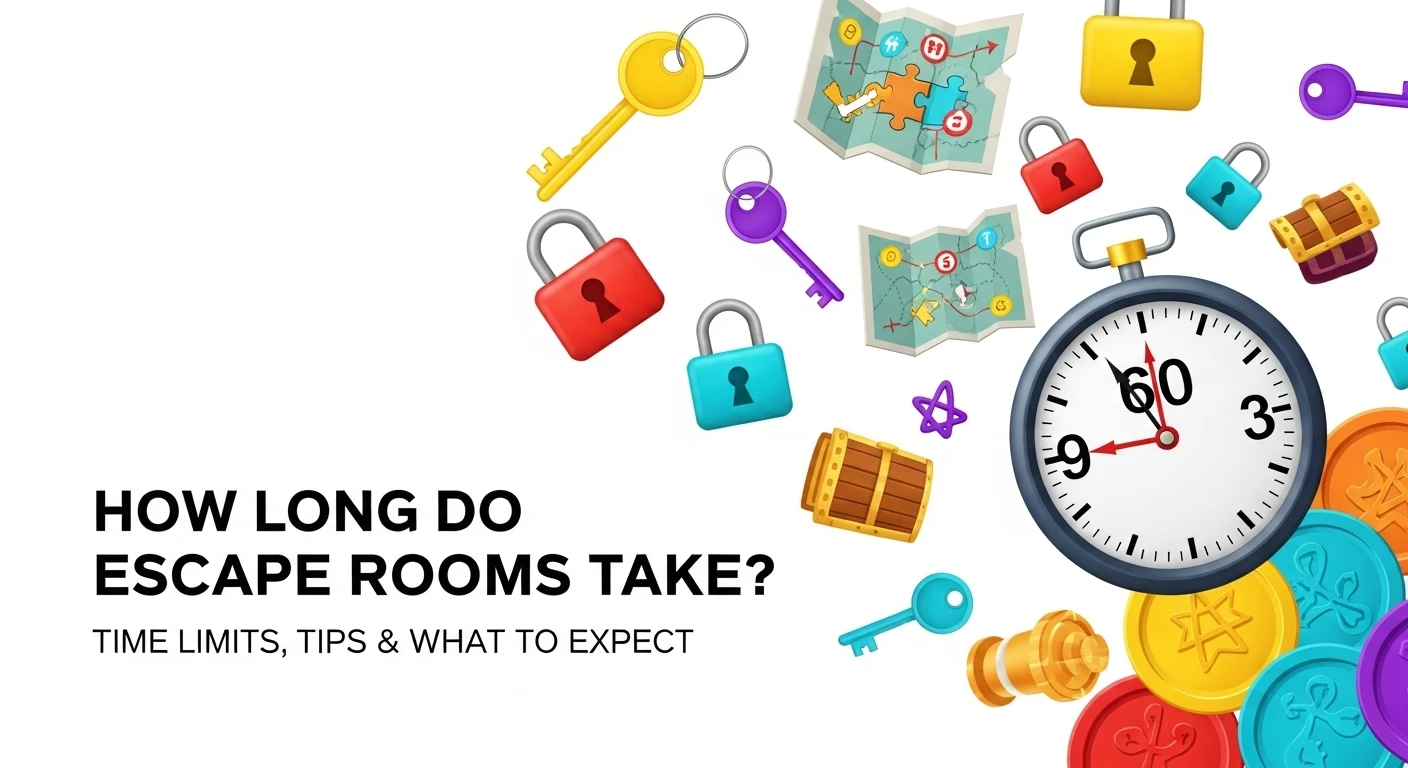
Wondering how long escape rooms take? Most run 60 minutes, but there's more to it. Discover time limits, what to expect, and tips to make every second count.

Scan to subscribe to EscaperX Blogger and Earn Points!.

Wondering how long escape rooms take? Most run 60 minutes, but there's more to it. Discover time limits, what to expect, and tips to make every second count.


The clock starts. A door locks behind you. Somewhere in this room is the key to your freedom — and you have exactly 60 minutes to find it.
That's the magic of an escape room. But if you've never done one before (or even if you have), you're probably asking a very reasonable question: how long do escape rooms actually take?
The short answer? Most escape rooms run 60 minutes. But the full answer is a little more interesting — and knowing it before you walk through that door can genuinely change your experience.
Whether you're planning a birthday outing, a team-building event, or just a fun Friday night with friends, this guide breaks down everything you need to know about escape room time limits, what happens before and after the game, and how to use every single minute wisely.
.png)
This is for you if you've ever:
First-timers, casual players, competitive puzzle-solvers, corporate team leaders — this guide is written for all of you. Because understanding the time structure of an escape room isn't just trivia. It genuinely shapes how relaxed, prepared, and successful you'll be.
An escape room is a live, interactive experience where a group of players is locked (or themed to be locked) inside a themed room. Your mission: solve a series of puzzles, find hidden clues, and escape before the timer runs out.
The "time limit" is the heart of the whole experience. It creates urgency. It builds pressure. It's what turns a simple puzzle game into a pulse-pounding adventure.
But here's what most people don't realize — the time limit is only part of your total time commitment when you visit an escape room venue.
Here's a realistic look at a typical escape room outing from arrival to exit:
| Phase | Typical Duration |
|---|---|
| Arrival & Check-in | 10–15 minutes |
| Safety briefing & rules | 5–10 minutes |
| The actual game | 45–90 minutes |
| Debrief / walkthrough | 5–15 minutes |
| Total visit time | ~90 minutes to 2 hours |
So while the game itself might be 60 minutes, your full visit will likely take closer to 90 minutes to two hours. Plan accordingly — especially if you're making dinner reservations afterward.
Here's the emotional truth: the clock is the game.
The time limit isn't just a countdown — it's the invisible pressure that makes your heart race when you're three puzzles deep and you just heard the gamemaster announce "30 minutes remaining." It's what makes the victory feel so satisfying when you finally hear that lock click open with seconds to spare.
But it also means that going in unprepared can turn what should be an exciting experience into a frustrating one. Players who don't know the structure often waste the first 15 minutes figuring out how things work. That's a quarter of your game time — gone.
Understanding escape room timing before you show up gives you a psychological edge. You'll start calmer, communicate better with your team, and make smarter decisions under pressure.
And right now, escape rooms are more popular than ever. According to industry data, there are over 50,000 escape room venues globally as of recent years — meaning more people than ever are doing this for the first time and walking in blind. Don't be that person.
Let's get specific. Here are the most common time limits you'll encounter:
The vast majority of escape rooms worldwide use a 60-minute time limit. It's the sweet spot — long enough to build a full story and challenge, short enough to maintain tension from start to finish.
Most escape rooms are designed so that a sharp, communicating team can finish in 45–55 minutes. That's intentional. The last few minutes are supposed to feel like a sprint.
.png)
Some venues offer shorter experiences, typically 45-minute rooms, aimed at:
These are great entry points. Don't underestimate them though — a well-designed 45-minute room can pack in just as much tension as a longer one.
On the higher end, you'll find 90-minute escape rooms — usually larger, more elaborate experiences with multiple rooms, branching storylines, or extra puzzles. These are often:
If you've done several escape rooms and want something that genuinely tests your skills, the 90-minute format is exhilarating.
Some entertainment venues or shopping centres offer 30-minute escape room kiosks — digital or semi-physical versions that give you a taste of the experience. These are fun but shouldn't be mistaken for the full escape room experience.
.png)
Now we get to the good stuff. Here's how to use every minute effectively.
Here's something first-timers worry about: what actually happens when the clock hits zero?
The answer? Nothing scary. No one drags you out. The gamemaster simply speaks over the intercom (or appears in person) and lets you know time is up. Then they walk you through the room and show you how everything connected.
The truth is, most groups don't escape on their first try — and that's completely normal. Escape room completion rates typically hover around 30–40% for standard difficulty rooms. Even seasoned players sometimes hit a wall.
Not escaping doesn't mean you failed. It means the room worked as designed. You'll still have had a great time — and you'll come back smarter next time.
.png)
Short answer: no, the clock is the same for everyone. But here's what does change:
These often include a pre-game briefing about team dynamics and a post-game debrief with a facilitator. Budget 2–3 hours total for the full corporate experience.
If you book a private room (just your group, no strangers), the experience runs the same time — but the dynamic feels completely different. No awkward introductions, just pure teamwork.
Online escape rooms, which exploded in popularity during the pandemic and remain popular today, typically run 45–75 minutes. They're slightly more forgiving on time since the setup is simpler, but they can be just as mentally taxing.
Designed for ages 7–14 typically, these run 30–45 minutes and feature simpler puzzles. A wonderful introduction to the format.
Can I get extra time if we're really close to escaping? Sometimes, yes. Some venues will give a final-minute grace hint or very occasionally extend time for groups who are genuinely one step away. But don't count on it. It's a treat, not a policy.
What if someone in my group needs a break? The clock doesn't stop for breaks, but you can step out if needed. Just know that every minute outside is a minute not solving. Most rooms are designed to allow for a moment's breathing room in the pacing.
Is 60 minutes a long time or a short time? It feels very short once you're inside. Sixty minutes in an escape room passes faster than 60 minutes of almost anything else. You'll be shocked how quickly time moves when your brain is fully engaged.
Can we pause the game? In most commercial escape rooms, no. The timer runs continuously. Some private or premium experiences may accommodate emergency pauses, but it's the exception.
An escape room isn't just a game. It's 60 minutes of pure, undivided presence — no phones, no distractions, just you, your team, and a puzzle that demands everything you've got.
Now that you know exactly how long escape rooms take, what that time looks like from start to finish, and how to use every minute effectively, you're not just a player. You're a prepared player. And that makes all the difference.
Whether it's your first time or your fifteenth, walk into that room with confidence, communicate like your freedom depends on it (because technically, it does), and enjoy every second of the adrenaline.
Ready to book your next escape room adventure? Find a venue near you, grab your team, and put everything you've learned here to the test. You've got 60 minutes.
0 Total Comments


 Back to Blogs