escaperx-favicon

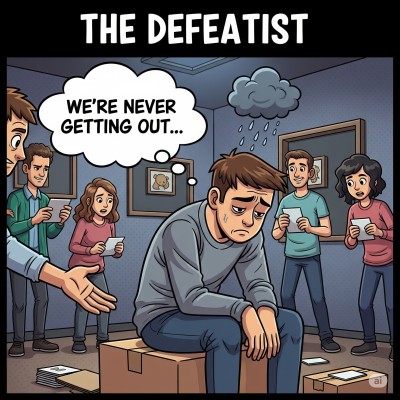
The Defeatist

Quickly gives up when things get difficult, doubting the teamโ€™s chances.

Escapers

members
1 Escapers USING THIS PERSONA
QR Code icon

Assign Persona Instantly

Scan the QR code to link and assign this persona seamlessly.
Quick, secure, and effortless your persona is just one scan away.

QR Code

The Defeatist: The Doubting Team Member ๐Ÿ˜Ÿ ๐Ÿง 

Escape rooms are designed to test creativity, communication, and perseverance under pressure. Every team brings together a mix of personalities that shape the overall experience ๐Ÿงฉ โฑ ๏ธ. Some players thrive on puzzles, others take charge as leaders, and some motivate the group with positivity. Yet among these varied personas, one often overlooked but very impactful role is The Defeatist ๐Ÿ˜Ÿ.


This persona is characterized by a tendency to doubt themselves, the puzzles, or even the team’s ability to succeed ๐ŸŒ€. While others push forward with determination, the Defeatist struggles with negativity and resignation.


Although their behavior may seem like a drag on the group, the Defeatist serves an important purpose ๐Ÿ’› ๐Ÿง : they highlight the value of resilience, optimism, and encouragement. When managed well, their presence becomes a teaching tool for the entire team  showing that perseverance is as crucial as problem-solving in achieving success ๐Ÿค โœจ.

Who Is The Defeatist in Escape Rooms? ๐Ÿ˜ž ๐Ÿงฉ

The Defeatist is the pessimistic and doubting team member who often expects failure before it happens โณ ๐Ÿ›‘. They lack confidence in their own abilities and sometimes project this doubt onto the group. Unlike the Panicker, who reacts to immediate stress with urgency, the Defeatist leans toward resignation, giving up quickly when things get hard ๐Ÿ˜ฐ.


Key traits of the Defeatist:

  • ๐Ÿ˜Ÿ Low Confidence: They second-guess themselves and hesitate to contribute ideas.
  • ๐Ÿšช Quick to Surrender: When a puzzle seems tough, they may abandon it prematurely.
  • ๐Ÿ“ฃ Verbal Negativity: They might say things like “We’re not going to solve this” or “We’ll never escape in time.”
  • โš– ๏ธ Influential on Morale: Their words and attitude can either discourage or, if managed well, inspire others to push back with positivity.
  • ๐Ÿ™ˆ Avoidance of Responsibility: Sometimes they step back from challenges out of fear of failing.

The Defeatist plays a distinct role in group psychology. While their negativity can drain energy, it also creates opportunities for teammates to step up, counter the doubt, and foster resilience ๐Ÿ’ฌ ๐Ÿ’ช.

Disappointment lingers beneath shifting focus.
Echoes reach through fractured self.

Why Does a Team Need a Defeatist in Escape Rooms? โš– ๏ธ

At first glance, the idea of “needing” a Defeatist seems counterintuitive. Why would a team want someone who doubts success? But the truth is that every persona, even the difficult ones, contributes to the team dynamic in unique ways ๐Ÿงฉ ๐Ÿค.

They Highlight the Importance of Perseverance ๐Ÿ’ช

Their quick surrender draws attention to the need for determination. Without a Defeatist, teams might not fully recognize how essential persistence is.

They Prompt Encouragement ๐ŸŒŸ

The Defeatist’s negativity can spark other members, like the Motivator, to step up and counteract it with positivity. This creates moments of bonding and support.

They Serve as a Morale Check ๐Ÿ“Š

When the Defeatist voices doubt, it forces the team to reflect: “Are we letting negativity creep in? How do we keep morale high?”

They Expose Weak Spots in Team Spirit ๐Ÿงฑ

Their attitude reveals whether the group has strong enough encouragement and leadership to withstand pessimism.

What Does The Defeatist Do in Escape Rooms? ๐Ÿง  ๐Ÿ’›

The Defeatist’s actions are not always helpful on the surface, but they shape the atmosphere in important ways ๐Ÿงฉ. Their behavior creates challenges that the team must respond to  and sometimes, those challenges strengthen group cohesion.

Reveals Team Doubts ๐Ÿ˜ž

By vocalizing their negativity, they bring to the surface doubts others may secretly share. This allows the team to address those fears directly.

Challenges Team Morale โš– ๏ธ

Their pessimism tests the team’s resilience. If morale crumbles, the Defeatist has too much influence. If the team pushes back, they grow stronger.

Highlights the Need for Encouragement ๐ŸŒŸ

Their presence naturally calls for counterbalancing positivity. Motivators, Leaders, and even Thinkers may rally to encourage and refocus the group.

Forces Team Members to Step Up ๐Ÿ”„

In reaction to negativity, teammates often take on new roles: the quiet player may speak up to encourage, or the Leader may shift into morale-building.

When Does The Defeatist Shine in Escape Rooms? ๐Ÿงญ

Though “shining” may not seem like the right word for someone defined by doubt, the Defeatist does bring value at specific moments ๐Ÿ˜Ÿ. Their negativity highlights the stakes and challenges, giving the team a chance to prove their resilience.

Thoughts unravel through silent pressure.

When Facing Difficult Challenges ๐Ÿง 

Their doubts underline just how tough a puzzle is  and motivate others to persevere in proving them wrong ๐Ÿ’ช ๐Ÿ”.

During Moments of Low Morale ๐Ÿ“‰

Ironically, their pessimism can prompt others to recognize morale is slipping and actively rebuild positivity. ๐ŸŒŸ ๐Ÿงฑ

When the Team Is Overconfident โš– ๏ธ

A Defeatist may temper excessive optimism, reminding the group that success requires effort, not assumption ๐Ÿงญ ๐Ÿง .

Throughout the Game as a Reality Check ๐Ÿ“Š

They serve as a constant reminder that victory isn’t guaranteed  making the team’s determination even more critical โฑ ๏ธ ๐Ÿค.

Ideas bloom through quiet reflection.

Where Does The Defeatist Make the Biggest Impact in Escape Rooms? ๐Ÿ’ฅ ๐Ÿค

The Defeatist’s influence is most strongly felt in environments where morale and persistence are critical ๐Ÿงฉ ๐Ÿ’ฌ. Their negativity can drag a team down, but it can also be the spark that makes others rise up.

  • ๐Ÿค In groups that rely heavily on encouragement, the Defeatist’s negativity can shake or strengthen the bonds depending on the response.
  • ๐Ÿง  The harder the puzzles, the more opportunities for the Defeatist to voice doubt  and for the team to practice perseverance.
  • โณ As the clock ticks down, their resignation forces the team to choose between despair and determination.
  • ๐Ÿง‘‍๐Ÿค‍๐Ÿง‘ New players may struggle more with doubt. Having a Defeatist can reveal the importance of fostering positivity early.

How Can You Be a Better Defeatist in Escape Rooms? ๐Ÿงฉ โš– ๏ธ

The Defeatist’s role doesn’t have to be purely negative. With self-awareness, they can transform from a morale risk into a constructive realist who ๐Ÿง  ๐Ÿ’ช challenges the group while still contributing to success.

Acknowledge Your Doubts ๐Ÿง 

Instead of suppressing feelings, recognize when negativity is rising. Awareness prevents it from spiraling.

Practice Positive Thinking ๐Ÿ”„

Reframe thoughts: instead of “We can’t solve this,” try “This is tough, but maybe we just need a new angle.”

Communicate Constructively ๐Ÿ’ฌ

Voice concerns in a way that helps, not hinders: “This path isn’t working  maybe we should try another.”

Focus on Small Wins ๐ŸŽ‰

Celebrate progress, even partial successes, to build confidence and momentum.

Final Thoughts: Importance of The Defeatist ๐Ÿง  ๐ŸŽฏ

Among the many personas that emerge in the high-pressure environment of escape rooms, few are as misunderstood as the Defeatist. Unlike the Adrenaline Junkie who thrives on energy, or the Explorer who hunts down hidden details, the Defeatist is often characterized by doubt ๐Ÿ˜ž ๐Ÿงฉ, resignation, and an inclination to give up when obstacles feel too daunting. At first glance, this persona may appear to hinder the team, dragging morale down and contributing little to the overall effort ๐Ÿ”ฅ. Yet, when we look deeper, the Defeatist reveals an important and even transformative role within the group dynamic.


The Defeatist embodies one of the greatest challenges of any escape room: perseverance in the face of setbacks โณ ๐Ÿ”. Escape rooms are designed to test resilience as much as they test intelligence. Locks won’t open, puzzles mislead, and the clock ticks down relentlessly, creating the illusion that success is slipping further away. In such moments, frustration and doubt naturally creep in ๐Ÿ•ฐ ๏ธ. The Defeatist simply externalizes what many participants may feel internally the fear that the team might not succeed. By voicing these doubts, they reflect a universal truth: success in escape rooms (and in life) rarely comes without struggle ๐Ÿ’ฌ.


However, this externalized doubt can cut two ways. If left unchecked, the Defeatist’s resignation can spread, creating a contagion of negativity โš– ๏ธ. Teammates may begin to internalize the doubts, second-guess their efforts, or lose the motivation to keep trying. This is why the Defeatist persona is often seen as a liability ๐Ÿ’ฌ. Yet the very same doubt that threatens to derail progress can also become the spark that galvanizes the team. When one member sinks into defeatist thinking, others often rise to counterbalance it. Encouragers, motivators, and natural leaders instinctively step in ๐Ÿงญ, rallying the group with optimism and determination. In this way, the Defeatist serves as an unintentional catalyst for resilience, prompting the team to strengthen their resolve ๐ŸŒŸ.


This paradox is what makes the Defeatist so vital. While their negativity might seem unhelpful, it provides the team with an opportunity to practice encouragement ๐Ÿ’›, empathy, and perseverance. Without a Defeatist in the room, some groups might never fully confront the emotional challenge of doubt. They may solve puzzles and open locks, but they would not experience the same depth of teamwork that comes from pulling a discouraged member back into the fold. In many cases, the Defeatist actually brings out the best in others by forcing them to demonstrate patience, compassion, and leadership under pressure. ๐Ÿค ๐Ÿง 

Users with this Persona

Rookie Escaper II

Mia Blaze

The Defeatist

Love this Persona? Make It Yours!

Do you see yourself in this persona?
Click below to add it to your profile and show the community who you are!

Claim This Persona

More Personas

The Mechanic

Expert in figuring out mechanical or logic-based puzzles.

The Analyst

Breaks down every challenge, thinking logically through each puzzle.

The Optimist

Encourages the team with positivity, even when things look tough.

The Motivator

Rallies the team during tough times, keeping spirits high.

The Panicker

Easily overwhelmed by the pressure, making hurried decisions.

The Adrenaline Junkie

Thrives on the excitement and fast pace of the game.

Escaperx Agent